
Do you recall what “party” George Washington represented? Was he a Democrat? Was he a Republican? I believe he was neither. I believe he would only classify himself as an “American.”
He was “the father” of of our nation, and he loved it like it was his child. Let’s be clear about this…, there would be no United States of America if it were not for George Washington.
President Washington’s integrity and patriotism were unquestioned. His only desire was to do what was best for his country and its citizens. It is in this regard that I feel President Trump has a lot in common with our country’s first president.

We all know that President Trump is technically a Republican, but do you really think his party affiliation is paramount to him? I don’t think so. I don’t think he’d have any problem being recognized as a Democrat, or working with Democrats, if they were joining with him in trying to do what was best for the country or We the People.
According to Chad Pergram of Fox News, “Senator Deb Fischer, R-Nebraska, will follow an annual tradition when the Senate next convenes. The first order of business is for Fischer to read George Washington’s Farewell Address aloud on the floor.”
I wonder how many Senators will be there in the Senate to actually hear the reading? Pergram says, “Most senators will be jetting back to the Beltway after the Presidents’ Day recess, not yet on the ground to hear Fischer’s presentation.”
George Washington’s complete Farewell Address is 32 handwritten pages. I encourage you to read it sometime. Below you’ll find sections of his address which I have selected for one reason or another, along with my own comments.
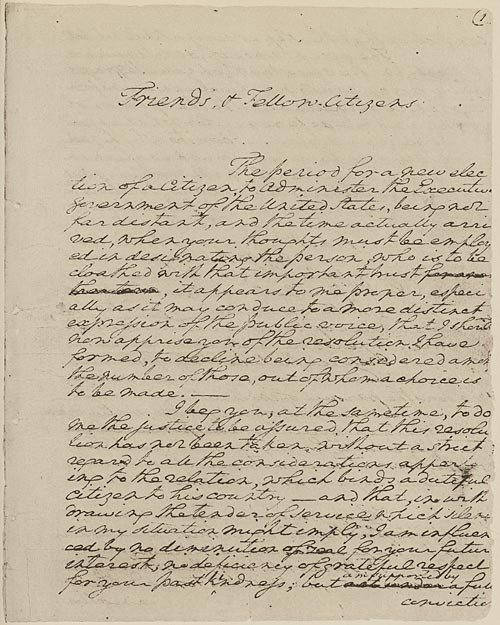
President Washington begins by addressing his “Friends and fellow citizens,”
“The period for a new election of a citizen, to administer the executive government of the United States, being not far distant, and the time actually arrived, when your thoughts must be employed designating the person, who is to be clothed with that important trust, it appears to me proper, especially as it may conduce to a more distinct expression of the public voice, that I should now apprize you of the resolution I have formed, to decline being considered among the number of those out of whom a choice is to be made.”
Washington’s second term is up, but he does not want another term, although he would almost unanimously be voted in.
“The unity of Government, which constitutes you one people, is also now dear to you. It is justly so; for it is a main pillar in the edifice of your real independence, the support of your tranquility at home, your peace abroad; of your safety; of your prosperity; of that very Liberty, which you so highly prize.”
Washington observes that the American people value and hold dear their new, unique, form of government.
“But as it is easy to foresee, that, from different causes and from different quarters, much pains will be taken, many artifices employed, to weaken in your minds the conviction of this truth; as this is the point in your political fortress against which the batteries of internal and external enemies will be most constantly and actively (though often covertly and insidiously) directed, it is of infinite moment, that you should properly estimate the immense value of your national Union to your collective and individual happiness; that you should cherish a cordial, habitual, and immovable attachment to it; accustoming yourselves to think and speak of it as of the Palladium of your political safety and prosperity; watching for its preservation with jealous anxiety; discountenancing whatever may suggest even a suspicion, that it can in any event be abandoned; and indignantly frowning upon the first dawning of every attempt to alienate any portion of our country from the rest, or to enfeeble the sacred ties which now link together the various parts.”
President Washington warns, however, that our government and our freedoms will come under attack from within our own country and from the outside, and that we must “cherish” and protect our way of life.
“The name of American, which belongs to you, in your national capacity, must always exalt the just pride of Patriotism, more than any appellation derived from local discriminations. With slight shades of difference, you have the same religion, manners, habits, and political principles. You have in a common cause fought and triumphed together; the Independence and Liberty you possess are the work of joint counsels, and joint efforts, of common dangers, sufferings, and successes.”
Washington says we should be proud to be called an American. He also points out what they all had in common at the time. This definitely is not the case anymore with most “Americans.”
“All obstructions to the execution of the Laws, all combinations and associations, under whatever plausible character, with the real design to direct, control, counteract, or awe the regular deliberation and action of the constituted authorities, are destructive of this fundamental principle, and of fatal tendency. They serve to organize faction, to give it an artificial and extraordinary force; to put, in the place of the delegated will of the nation, the will of a party, often a small but artful and enterprising minority of the community; and, according to the alternate triumphs of different parties, to make the public administration the mirror of the ill-concerted and incongruous projects of faction, rather than the organ of consistent and wholesome plans digested by common counsels, and modified by mutual interests.”
Washington warns here of the dangers of “factions” and “enterprising minorities” putting their wants ahead of what is best for the nation as a whole.

“I have already intimated to you the danger of parties in the state, with particular reference to the founding of them on geographical discriminations. Let me now take a more comprehensive view, and warn you in the most solemn manner against the baneful effects of the spirit of party, generally.”
“This spirit, unfortunately, is inseparable from our nature, having its root in the strongest passions of the human mind. It exists under different shapes in all governments, more or less stifled, controlled, or repressed; but, in those of the popular form, it is seen in its greatest rankness, and is truly their worst enemy.”
“The alternate domination of one faction over another, sharpened by the spirit of revenge, natural to party dissension, which in different ages and countries has perpetrated the most horrid enormities, is itself a frightful despotism. But this leads at length to a more formal and permanent despotism. The disorders and miseries, which result, gradually incline the minds of men to seek security and repose in the absolute power of an individual; and sooner or later the chief of some prevailing faction, more able or more fortunate than his competitors, turns this disposition to the purposes of his own elevation, on the ruins of Public Liberty.”
Are the results of putting party ahead of country not deteriorating our liberty on a daily basis?
“Without looking forward to an extremity of this kind, (which nevertheless ought not to be entirely out of sight,) the common and continual mischiefs of the spirit of party are sufficient to make it the interest and duty of a wise people to discourage and restrain it.”
Washington advises us to keep our eyes open, to be aware of those who would threaten our liberty and our country, and to fight against them and their efforts.
“It serves always to distract the Public Councils, and enfeeble the Public Administration. It agitates the Community with ill-founded jealousies and false alarms; kindles the animosity of one part against another, foments occasionally riot and insurrection. It opens the door to foreign influence and corruption, which find a facilitated access to the government itself through the channels of party passions. Thus the policy and the will of one country are subjected to the policy and will of another.”
“There is an opinion, that parties in free countries are useful checks upon the administration of the Government, and serve to keep alive the spirit of Liberty. This within certain limits is probably true; and in Governments of a Monarchical cast, Patriotism may look with indulgence, if not with favor, upon the spirit of party. But in those of the popular character, in Governments purely elective, it is a spirit not to be encouraged. From their natural tendency, it is certain there will always be enough of that spirit for every salutary purpose. And, there being constant danger of excess, the effort ought to be, by force of public opinion, to mitigate and assuage it. A fire not to be quenched, it demands a uniform vigilance to prevent its bursting into a flame, lest, instead of warming, it should consume.”
We have to stay on top of these people who attempt to sway our fellow citizens into forgetting why our country was formed and pretend to have a better way, while trying to drive a wedge between our citizens and between our citizens and their country.
“Against the insidious wiles of foreign influence (I conjure you to believe me, fellow-citizens,) the jealousy of a free people ought to be constantly awake; since history and experience prove, that foreign influence is one of the most baneful foes of Republican Government. But that jealousy, to be useful, must be impartial; else it becomes the instrument of the very influence to be avoided, instead of a defense against it. Excessive partiality for one foreign nation, and excessive dislike of another, cause those whom they actuate to see danger only on one side, and serve to veil and even second the arts of influence on the other. Real patriots, who may resist the intrigues of the favorite, are liable to become suspected and odious; while its tools and dupes usurp the applause and confidence of the people, to surrender their interests.”
No matter what other foreign governments may say, they do not have our best interests at heart unless it benefits them. We must put America first and guard her interests.

“The great rule of conduct for us, in regard to foreign nations, is, in extending our commercial relations, to have with them as little political connection as possible. So far as we have already formed engagements, let them be fulfilled with perfect good faith. Here let us stop.”
“Taking care always to keep ourselves, by suitable establishments, on a respectable defensive posture, we may safely trust to temporary alliances for extraordinary emergencies.”
“In offering to you, my countrymen, these counsels of an old and affectionate friend, I dare not hope they will make the strong and lasting impression I could wish; that they will control the usual current of the passions, or prevent our nation from running the course, which has hitherto marked the destiny of nations. But, if I may even flatter myself, that they may be productive of some partial benefit, some occasional good; that they may now and then recur to moderate the fury of party spirit, to warn against the mischiefs of foreign intrigue, to guard against the impostures of pretended patriotism; this hope will be a full recompense for the solicitude for your welfare, by which they have been dictated.
George Washington, United States – September 17, 1796
Source: “The Independent Chronicle” newspaper, September 26, 1796.
You have to love George Washington. He was a great leader and an eloquent communicator.
I wonder what he would do with “Twitter” today?
What would he have to say about “the fake news?”
What would he say about this growing support of Socialism and “open borders?”
I believe President Trump is representing President Washington’s beliefs quite well for the time being.
NOTE: If you’re not already “following” me and you liked my blog(s) today, please scroll down to the bottom of this site and click the “Follow” button. That’ll keep you up to date on all of my latest posts.
Thank you, MrEricksonRules.


 Mr. Erickson Rules!