
Or, maybe the question is are “they” trying to kill us, or at least make us sick, with their greed?
Big Pharma sure doesn’t mind supplying us the meds to deal with the problems caused by their friends in big business and the FDA (Food and Drug Administration).

In some cases, can our food even really be considered “food?”
Or, is it more like a lab experiment?
As it turns out, I was surprised to learn that not all “food” is created equal.
Freya Drohan, for DailyMail.com, reports, “Food blogger reveals the shocking differences between U.S. and U.K. ingredients lists, accusing American brands of trying to ‘poison consumers’ with high numbers of additives and chemicals.”
“Vani Hari, aka the Food Babe, describes herself as a healthy-living activist. The North Carolina-based blogger routinely calls out shady ingredients.”

“She recently showed the discrepancies between ingredients of packaged food sold commonly in the U.S. and the U.K.”
My first thought is why would there be any difference at all?
My second thought is, what happened to all of those consumer watchdog reporters and shows we used to have?
Anyway…, why would a company go out of its way to produce a product in two completely different ways?
“Vani regularly takes on large corporations over their use of certain additives.”
“She has previously come under fire for having no science/nutrition background.”
Oh, I bet she has!
I guess you don’t specifically need a science or nutrition background to read a label though, do you?
And we all remember the term “follow the science,” don’t we?

We found out if you follow the science it leads to people with a lot of money dictating what the proper “science” is.

“Vani Hari, who goes by the moniker The Food Babe online, showed the differences between common bodega goods like chips and soda and how they are formulated on each side of the Atlantic.”
“The author and campaigner, 38, shared her findings with her audience, who were horrified to see ingredients like the preservative BHT (butylated hydroxytoluene) and artificial colorings in products sold to American consumers while the British versions and the Australian and the Canadian [versions] come without.”
“Yikes! A packet of Doritos sold in America is shown to contain controversial chemical compounds like Red 40, Blue 1 and Yellow 5”
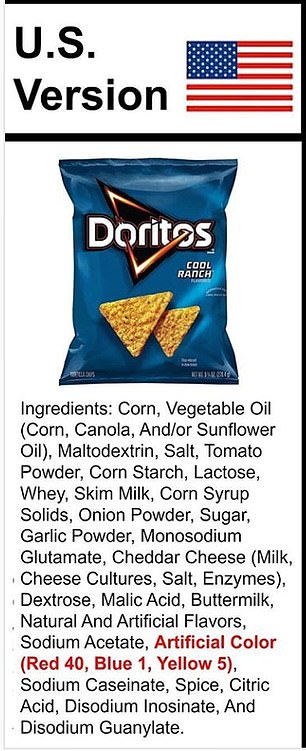
“…but they aren’t used on the U.K. version.”

“While calling out the differences, she slammed the food companies involved for ‘poisoning consumers for profit.’”
Noooooo! Can you imagine food companies doing that?!
‘“Although artificial dyes are common in America, that doesn’t make them safe to eat,’ Vani said.”
“She explained that in Europe, food companies are required to include warning labels if they use artificial dyes – hence many opt not to use them.”
‘“That’s one reason the U.K. version is so different,’ she added.”
‘“Companies don’t want to slap warnings all over food packages because that wouldn’t be good for business. To make matters worse, they add high fructose corn syrup, cellulose gum, and artificial preservatives to the U.S. version.’”
“Complicated: In America, Heinz’ classic tomato ketchup appears to have more convoluted ingredients compared to its British counterpart.”


“She believes that U.S. companies continue to sell the artificial ingredient-laden products because they’re cheaper to produce and they can get away with it.”
“For example, she calls out the way Red 40 is used in the production of Doritos in America.”
“Red 40 is a certified color that comes from petroleum distillates or coal tars and The U.S. Food and Drug Administration (FDA) mandates that it has to be listed by name on food and product labels.”
“Healthline writes that according to the Center for Science in the Public Interest, Red 40 and other AFCs can cause allergic reactions in some people.”
“Research shows they can also cause hyperactivity in children and immune system tumors in mice.”
Wonderful.
“Red 40 also contains p-Cresidine, which the U.S. Department of Health and Human Services says is reasonably anticipated to be a human carcinogen (cancer forming).”
“Vani reveals that the controversial dye is also included in Quaker Strawberries and Cream oatmeal – while in the U.K., they include freeze dried pieces of actual fruit.”
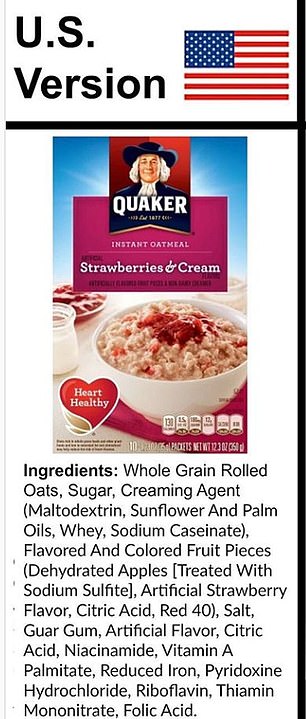

You mean in the U.K. the actually use real fruit in this product?!
No wayyyyyy!
“In the U.K., Mountain Dew energy drink gets its bright yellow color from beta carotene (a natural color derived from carrots and other orange/yellow foods) but in the U.S., where the drink is manufactured by PepsiCo, it’s a different story.”

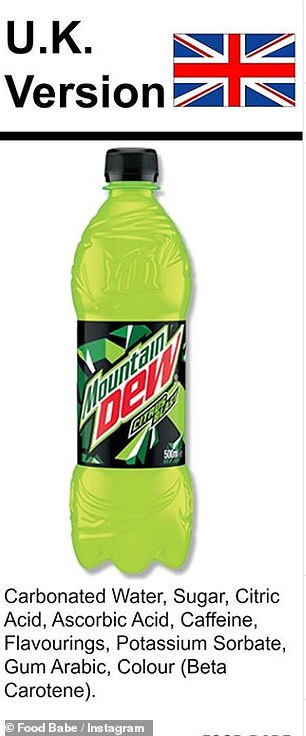
“Vani writes that its color comes from Yellow 5, aka a petroleum-based dye called Tartrazine. Much has been written about Tartrazine since the 1990s, when it was rumored to affect reproduction in males.”
So, it’s a form of birth control?
“However, to this day, most studies on Tartrazine have been carried out on rats but it is acknowledged, in general, that children who consume large doses of artificial food colorings have been affected ‘negatively’ compared to those who received less.”
When you say “rats,” are these democrats, or the actual rat animals?
“Color: Sunny D manufacturers also utilize Yellow 5 aka Tartrazine in the U.S., whereas they do not in the U.K.”
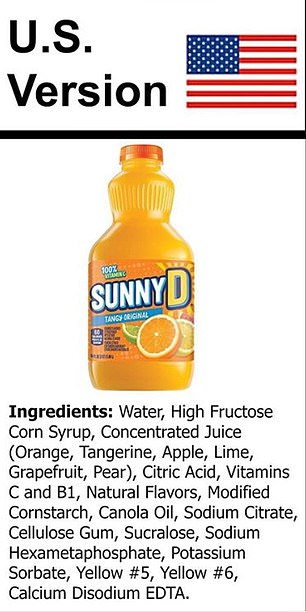
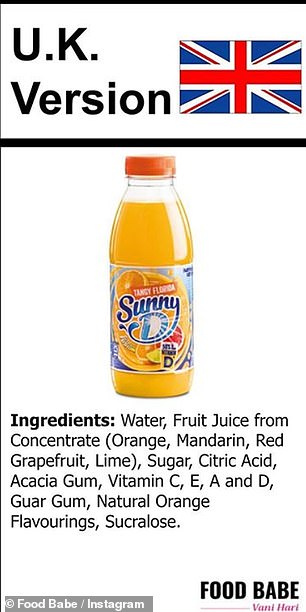
“Spot the difference: Vani also calls out the differences between the same products when sold in the U.S. and Australia.”


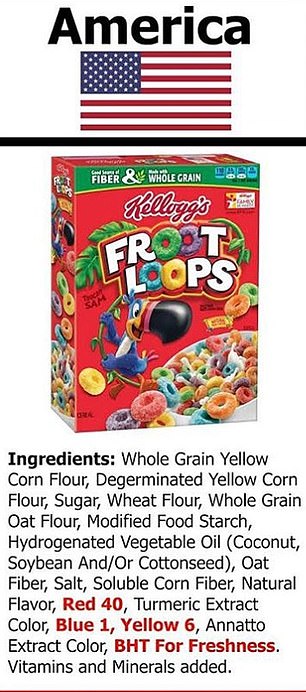
“Earlier this month, the cereal company Kellogg’s responded to Vani after a petition for them to stop adding the preservative BHT (butylated hydroxytoluene) and artificial food dyes to their children’s cereals.”
“While Kellogg’s said they ‘won’t sacrifice the great taste and quality’ by removing the ingredients, Vani was pleased that they had taken note of the criticism.”
“Campaign: Vani took on Kellogg’s, asking for years that they remove BHT and artificial food dyes like Red 40 included in their U.S. products but not in other countries like Canada.

“After another relentless social media campaign, Subway removed azodicarbonamide, a chemical in its bread also found in yoga mats.”
Oh, yummy!
“It’s probably cheaper to produce the US versions [there’s no doubt about that]. And the side effect of years of consuming this crap produces lots of people needing expensive healthcare. An infinite circle of profit (has anyone checked to see how many healthcare companies own food stocks and vice versa?).”
“The world is not as it seems. We are deliberately being poisoned in our air, water, and food supply.”
It’s pretty hard to argue that this isn’t the case, at this point.
If you’re not already “following” me and you liked my blog(s) today, please share them, and please choose to “follow” me, which will keep you up to date on all of my latest posts, and/or leave me a comment. I value your feedback and I’d love to hear from you!
Thank you, MrEricksonRules.




 Mr. Erickson Rules!