Is Our Food Killing Us?!

Or, maybe the question is are “they” trying to kill us, or at least make us sick, with their greed?

Big Pharma sure doesn’t mind supplying us the meds to deal with the problems caused by their friends in big business and the FDA (Food and Drug Administration).    

In some cases, can our food even really be considered “food?”

Or, is it more like a lab experiment?

As it turns out, I was surprised to learn that not all “food” is created equal. 

Freya Drohan, for DailyMail.com, reports, “Food blogger reveals the shocking differences between U.S. and U.K. ingredients lists, accusing American brands of trying to ‘poison consumers’ with high numbers of additives and chemicals.”

“Vani Hari, aka the Food Babe, describes herself as a healthy-living activist. The North Carolina-based blogger routinely calls out shady ingredients.”

“She recently showed the discrepancies between ingredients of packaged food sold commonly in the U.S. and the U.K.”

My first thought is why would there be any difference at all?

My second thought is, what happened to all of those consumer watchdog reporters and shows we used to have?   

Anyway…, why would a company go out of its way to produce a product in two completely different ways?

“Vani regularly takes on large corporations over their use of certain additives.”

“She has previously come under fire for having no science/nutrition background.”

Oh, I bet she has!

I guess you don’t specifically need a science or nutrition background to read a label though, do you?

And we all remember the term “follow the science,” don’t we?

We found out if you follow the science it leads to people with a lot of money dictating what the proper “science” is.

“Vani Hari, who goes by the moniker The Food Babe online, showed the differences between common bodega goods like chips and soda and how they are formulated on each side of the Atlantic.”

“The author and campaigner, 38, shared her findings with her audience, who were horrified to see ingredients like the preservative BHT (butylated hydroxytoluene) and artificial colorings in products sold to American consumers while the British versions and the Australian and the Canadian [versions] come without.”

“Yikes! A packet of Doritos sold in America is shown to contain controversial chemical compounds like Red 40, Blue 1 and Yellow 5”
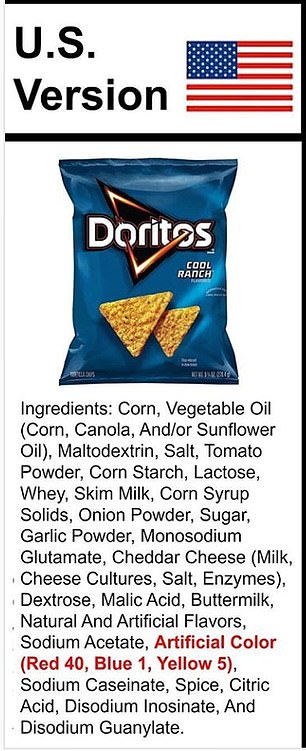
“…but they aren’t used on the U.K. version.”

“While calling out the differences, she slammed the food companies involved for ‘poisoning consumers for profit.’”

Noooooo! Can you imagine food companies doing that?!

‘“Although artificial dyes are common in America, that doesn’t make them safe to eat,’ Vani said.”

“She explained that in Europe, food companies are required to include warning labels if they use artificial dyes – hence many opt not to use them.”  

‘“That’s one reason the U.K. version is so different,’ she added.”

‘“Companies don’t want to slap warnings all over food packages because that wouldn’t be good for business. To make matters worse, they add high fructose corn syrup, cellulose gum, and artificial preservatives to the U.S. version.’”

“Complicated: In America, Heinz’ classic tomato ketchup appears to have more convoluted ingredients compared to its British counterpart.”

“She believes that U.S. companies continue to sell the artificial ingredient-laden products because they’re cheaper to produce and they can get away with it.”

“For example, she calls out the way Red 40 is used in the production of Doritos in America.”

“Red 40 is a certified color that comes from petroleum distillates or coal tars and The U.S. Food and Drug Administration (FDA) mandates that it has to be listed by name on food and product labels.”

“Healthline writes that according to the Center for Science in the Public Interest, Red 40 and other AFCs can cause allergic reactions in some people.”

“Research shows they can also cause hyperactivity in children and immune system tumors in mice.”

Wonderful.  

“Red 40 also contains p-Cresidine, which the U.S. Department of Health and Human Services says is reasonably anticipated to be a human carcinogen (cancer forming).”

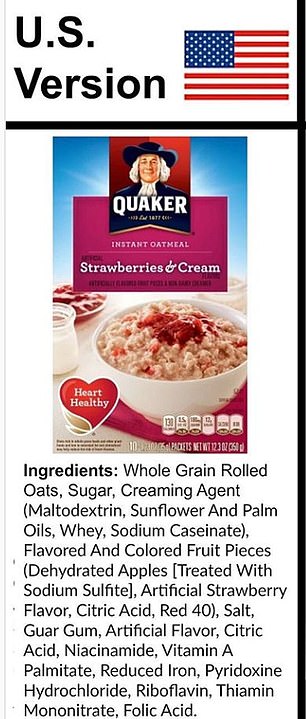
“Vani reveals that the controversial dye is also included in Quaker Strawberries and Cream oatmeal – while in the U.K., they include freeze dried pieces of actual fruit.”
You mean in the U.K. the actually use real fruit in this product?!

No wayyyyyy!

“In the U.K., Mountain Dew energy drink gets its bright yellow color from beta carotene (a natural color derived from carrots and other orange/yellow foods) but in the U.S., where the drink is manufactured by PepsiCo, it’s a different story.”

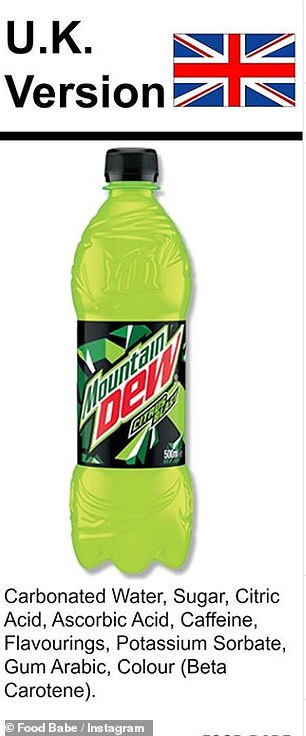
“Vani writes that its color comes from Yellow 5, aka a petroleum-based dye called Tartrazine. Much has been written about Tartrazine since the 1990s, when it was rumored to affect reproduction in males.”

So, it’s a form of birth control?

“However, to this day, most studies on Tartrazine have been carried out on rats but it is acknowledged, in general, that children who consume large doses of artificial food colorings have been affected ‘negatively’ compared to those who received less.”

When you say “rats,” are these democrats, or the actual rat animals?    

“Color: Sunny D manufacturers also utilize Yellow 5 aka Tartrazine in the U.S., whereas they do not in the U.K.”
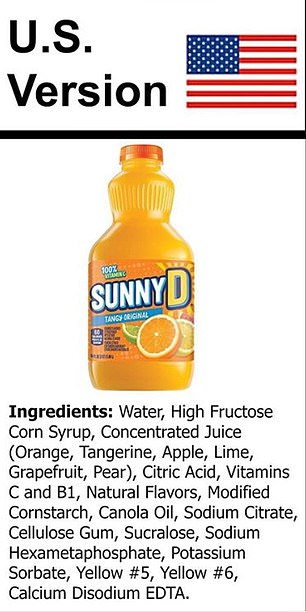
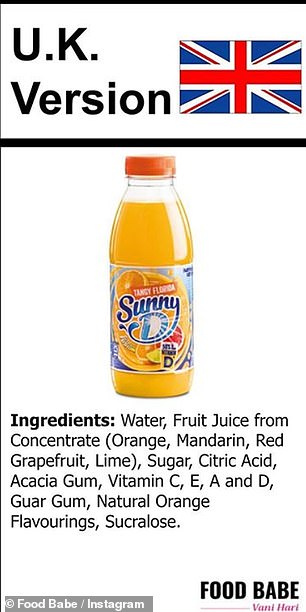
“Spot the difference: Vani also calls out the differences between the same products when sold in the U.S. and Australia.”

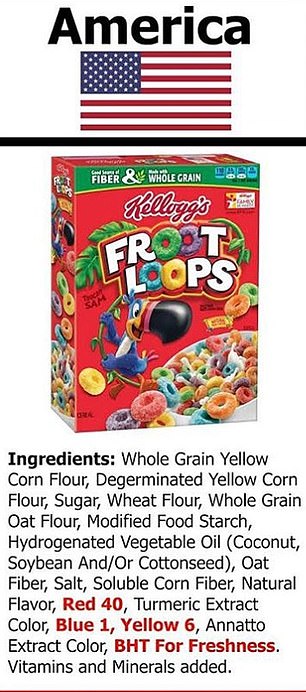
“Earlier this month, the cereal company Kellogg’s responded to Vani after a petition for them to stop adding the preservative BHT (butylated hydroxytoluene) and artificial food dyes to their children’s cereals.”

“While Kellogg’s said they ‘won’t sacrifice the great taste and quality’ by removing the ingredients, Vani was pleased that they had taken note of the criticism.”

“Campaign: Vani took on Kellogg’s, asking for years that they remove BHT and artificial food dyes like Red 40 included in their U.S. products but not in other countries like Canada.
“After another relentless social media campaign, Subway removed azodicarbonamide, a chemical in its bread also found in yoga mats.”

Oh, yummy!

“It’s probably cheaper to produce the US versions [there’s no doubt about that]. And the side effect of years of consuming this crap produces lots of people needing expensive healthcare. An infinite circle of profit (has anyone checked to see how many healthcare companies own food stocks and vice versa?).”

“The world is not as it seems. We are deliberately being poisoned in our air, water, and food supply.”

It’s pretty hard to argue that this isn’t the case, at this point. 

If you’re not already “following” me and you liked my blog(s) today, please share them, and please choose to “follow” me, which will keep you up to date on all of my latest posts, and/or leave me a comment.   I value your feedback and I’d love to hear from you!

Thank you, MrEricksonRules.

Are You “Morbidly Obese?”

That clinical term seems quite demeaning, but by definition, there’s a good chance you are!

According to a 2020 Harvard study, “1 out of every 3 U.S. adults is obese.”

And this number has since increased to over 40% of adults being considered “obese,” and over 70% considered to be “overweight.”

Wow! That seems like we’re talking about a real general health problem.

But, first, let’s define what we’re talking about here.

Let’s start with the word “morbidly.”

The Oxford Languages Dictionary defines “morbidly” as, “Characterized by or appealing to an abnormal and unhealthy interest in disturbing and unpleasant subjects, especially death and disease.”

Hmmm…, does this seem like an appropriate adjective to attach to someone’s weight classification?

Who came up with this troubling label? Someone who was “morbidly skinny?”

Synonyms of “morbidly” are listed as, “Ghoulish, unhealthy, gruesome, grotesque, and horrible.”

Isn’t this taking the description of a weight classification a bit far?

You should be nodding your head.  

According to WebMD.com:

“Obesity is determined by your body mass index (BMI). This score is calculated by finding your height and weight on the BMI chart. Morbid obesity is defined by a BMI of 40 or greater.”

So, the key to this whole thing is the BMI chart.

But, where did this BMI chart come from?

It must have been a result of a collection of verifiable and scientific studies, performed by certified medical professionals, right?  

Actually, no. BMI was invented in the 1830s by a Belgian statistician, sociologist, astronomer and mathematician by the name of Lambert Adolphe Jacques Quetelet. It was known then as the Quetelet Index and was informed by Quetelet’s interest in finding what would be the definition of the “average man.”

Hmmm.

First off, so, women are just out of luck? Whoever extrapolated these very unscientific numbers for men into equally unscientific numbers for women the first place is anyone’s guess.

Anyway, let’s proceed.   

Sooo, this concept was arrived at close to 200 years ago, and I noticed that healthcare, medicine, or nutrition were not listed as any of Quetelet’s areas of expertise.

But this antiquated and unscientific chart has been adopted and used by our modern healthcare system as “The Bible” for weight health anyway?

Interesting.

Stupid, but interesting.

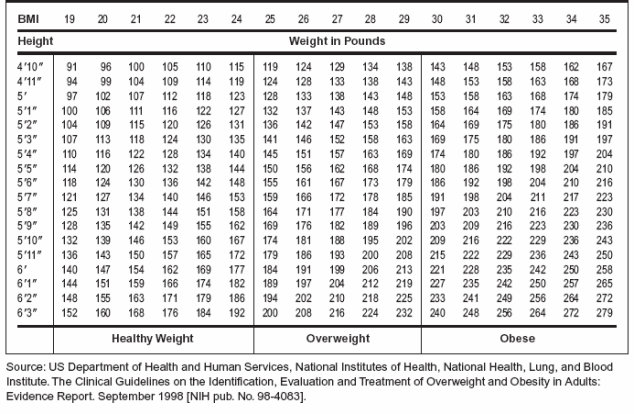
Here is the (BMI) Body Mass Index chart.

When you use a BMI chart to determine how healthy your weight is, you’ll find a corresponding number to your height and weight:

If you have a BMI of less than 18.5, you are considered to be in the underweight range.

If you have a BMI of 18.5 to less than 25, you are considered to be in the healthy weight range.

If you have a BMI of 25.0 to less than 30, you are considered to be in the overweight range.‌

If you have a BMI of 30.0 or higher, you are considered to be in the obesity range.

Additionally, health experts divide obesity into three separate categories of severity:

Obesity class 1: BMI between 30 and less than 35

Obesity class 2: BMI between 35 and less than 40‌

Obesity class 3: BMI of 40 or higher‌

Class 3 obesity is also categorized as “severe” obesity, or as being “morbidly obese,” if you are 100 pounds heavier than your recommended weight. You may also be considered “morbidly obese” if you have a BMI of 35 or more and have obesity-related health conditions like high blood pressure or diabetes.

But, like I said earlier, “The key to this whole thing is the BMI chart, which is based on height and weight (At least from 200 years ago!).”

The average height for a male in the United States these days is 5 feet 9 inches, which, according to the BMI chart, means the average healthy male in the United States should weigh between 128-162 pounds.

I’m not a healthcare expert (but neither was the creator of the BMI chart), but doesn’t that weight range seem a bit light?  

I, personally, am 6 feet tall. Which means I should weigh between 140-177 pounds.

Hmmm, really?

The last time I weighed 177 pounds was probably in my early high school days, and the last time I weighed 140 pounds was probably in 5th or 6th grade!

Even at the healthiest, and most fit, time of my life, when I served in the U.S. Marine Corps, based on the chart, I would have been considered “overweight.”

I currently weigh around 260 pounds, which is off the BMI chart for my height, so I am considered “morbidly obese.”

I realize I weigh more than I probably should at this point, but I don’t consider myself obese, and certainly not “morbidly obese.”

And I’m certainly not going to judge myself by the size of men from 200 years ago in Belgium, or by someone’s idea from that time period of what a “healthy” weight was!

And I’m admittedly confused and concerned as to why healthcare professionals would choose to judge me by that criteria.

Healthcare recommendations are made based on this BMI chart.

Medications are prescribed based on this BMI chart.

Some Healthcare Insurance coverage is based on this BMI chart.

And all of this ill-advised behavior is taking place based on an antiquated, unscientific, and out of date information, in addition to people feeling it is appropriate to call someone “morbidly obese.”

Why do healthcare “professionals” feel it is okay to disparage individuals who have an issue with their weight? What other group of people is it okay to insult and negatively label?

I’m not a big fan of people being offended by everything, but I feel referring to someone as “morbidly obese” is offensive.    

I would respectfully like these healthcare system individuals to consider their weight classifications as outdated, discriminatory, derogatory, inconsiderate, and unthoughtful.

If you feel comfortable referring to me as “ghoulish, gruesome, grotesque, and horrible,” because I weigh a little more than I probably should, I’ve got a few adjectives of my own I’d like to throw back at you, like “unprofessional, irresponsible, and insensitive.”

Can we all agree, at this point, that this archaic BMI chart should be ditched, or at least updated?

Can we all agree that this centuries old chart, created by someone with no medical or health credentials, should be delegitimized and retired?

Can we all agree that it should never be okay to label someone as “ghoulish, gruesome, grotesque, and horrible,” unless their behavior justifies it?

We should all be able to agree that the healthcare system needs to drag itself out of the 19th century and into the 21st century.

Just sayin’.  

If you’re not already “following” me and you liked my blog(s) today, please choose to “follow” me, which will keep you up to date on all of my latest posts, and/or leave me a comment.  I value your feedback and I’d love to hear from you!

Thank you, MrEricksonRules.
“Balance of Nature?!”

I’m afraid not.

It’s more like the Imbalance of Unnatural bullsh#t.

Really, what in the h#ll is “natural” about swallowing capsules filled with pulverized and dried out plant material?

I’ve written about what a rip-off Balance of Nature is before, but I just have to call out these snake oil again.  

If you haven’t seen the commercials for “Balance of Nature,” they have people claiming that taking these little miracle capsules, filled with this magical fruit and veggie powder, has cured any number of ailments.

They claim taking these magical capsules has turned their lives around.

They claim taking these magical capsules has brought them back from the brink of virtual life-ending incapacity.  

“I could barely walk anymore, but now thanks to Balance of Nature I’m running marathons again!”

Hmmm…, let’s take a closer look.

“Balance of Nature” suggests we take just of their 3 fruit capsules and 3 veggie capsules per day.

If you take a look at the size of these capsules, this is like the equivalent of eating 3 strawberries and maybe 1 small carrot a day!

Wow!

And this is their miraculous cure all?!

That’s all it takes to turn an unhealthy life around?

That’s the fountain of youth for older customers who thought their lives were over?

They claim to “pack 10 servings of fruits and vegetables into 6 tiny capsules.”

Can we use a little common sense here?

Just a little?

I don’t care how much you dry out and smash and grind up something…, it is still going to take up the same basic amount of space.  It’s just basic science.

These people want us to believe they have their own “Honey, I shrunk the fruits and veggies” process.

Well, they don’t.

Can we all agree on that?

I hope you’re nodding your head up and down.

Now we can proceed.

So, when we look at their bottle of fruits capsules and their bottle of veggies capsules, it’s like the equivalent of buying a couple bananas, a couple of apples, and a head of broccoli.

And for the equivalent of a couple bananas, a couple of apples, and a head of broccoli, you get to spend $89.95…, plus tax!  That comes to about 50 cents per capsule.

That’s for a “thirty day supply.”

But, hey, shipping is free!

They say, “This is how nature intended” us to get our fruits and veggies!”

Really?!

What kind of plant grows those “natural” plastic capsules that they fill with their “natural” fruit and veggie powder?  

Do you realize how many real fruits and real vegetables you could buy for $90?

On the flip side, taking these capsules certainly won’t hurt.  And if you typically don’t eat ANY fruits or vegetables, taking these capsules is better than nothing…, but not by much. They certainly are not going to change your life or significantly improve your health.

People would be much better off investing in a bottle of good daily multi-vitamins, a bag of apples and a bag of carrots, at a fraction of what these miracle capsules cost.

So, the next time you see one of these commercials, and watch some person praising “Balance of Nature” for turning their life around, please know their life may have turned around for some reason, but it wasn’t because they took these little miracle capsules.   

If you’re not already “following” me and you liked my blog(s) today, please choose to “follow” me, which will keep you up to date on all of my latest posts, and/or leave me a comment.  I value your feedback and I’d love to hear from you!

Thank you, MrEricksonRules.
Blog at WordPress.com.

Up ↑