Again, what we should do if we REALLY want to solve the school shootings problem and make our schools “safe zones”:

We could prevent almost 100% of “school shootings” if each school had protective fencing with one main gate or entrance, on the perimeter of the actual campus or school, which was monitored by security personnel along with metal detectors.

It’s as simple as that.

All we need to do is pass a “safe school” spending bill to get the ball rolling, and within a year or so we will have addressed the immediate issue.

At the same time, we can work on changing how we do background checks when purchasing a weapon or ammunition. Our checks need to be more extensive and more comprehensive.  Social media should be checked and the community where the purchaser lives should be canvassed for input as to whether anyone has objections to this individual owning a weapon.

Access to mental health resources has to be greatly enhanced as well. When people are experiencing issues or are aware of others with issues, assistance needs to be available right then, not a month or two, or three, down the road when a psychiatrist’s or a psychologist’s schedule has an opening.  Mental health, in general, has to be just as much of a consideration as physical health.  In too many cases the insurance companies are dictating the type of help we can get and when.  This has to change.

Then finally, the President should establish a component agency that would fall under The Department of Homeland Security and deal solely with the issues that affect school security.

I see that arming and training our teachers is being advanced by quite a few people. This may seem like a good idea to deter an intruder, but what about when the shooter is a student at the school (which is the case is most situations)?  Do we want that image of teachers gunning down students in school?  Do we want our schools to become “the shootout at the O.K. Corral, or do we want to avoid that situation from occurring in the first place?

Enhancing our background checking system is something that must be done, but also something that can’t be counted on as our last line of defense either. In the case of the Parkland, Florida shooter, there were more red flags raised on this kid than you’d see at a Chinese military parade!  I mean, it doesn’t get any better than this case as far as warning signs, and he still was not stopped.

There are many other ideas that have merit as well, and there’s no reason we can’t attack this problem from a hundred different angles at the same time. But, again…

We could prevent almost 100% of “school shootings” if each school had protective fencing with one main gate or entrance, on the perimeter of the actual campus or school, which was monitored by security personnel along with metal detectors.

It’s as simple as that.

safe school zone smaller


Propaganda…, it’s not just for communists and dictators anymore!

Propaganda is a means of persuasion.  It works by tricking us, by momentarily distracting us while the rabbit pops out of the hat.  Propaganda works best with an audience that isn’t really paying attention.

Joseph Goebbels, the Propaganda Minister in Nazi Germany, once defined his work as “the conquest of the masses.” The masses would not have been conquered, however, if they had known how to challenge and to question, how to make distinctions between propaganda and reasonable arguments and reports.

People are fooled because they don’t recognize propaganda when they see it. They need to be informed about the various devices that can be used to mislead and deceive, about the propagandists’ overflowing bag of tricks.

It’s kind of insidious actually, when you think about it. Some of these politicians and media outlets are intentionally scripting what they say in order to sway our beliefs and illegitimately gain our support and their control over us.

It’s scary. We all really need to stay on our toes and be wary of pre-packaged propaganda when we see it.

Here are some of the common tricks propagandists use:

  1. Name Calling

This device consists of labeling people or ideas with words of bad connotation, literally, “calling them names.” Here the propagandist tries to arouse our anger so we will dismiss the person or their idea without examining its merits. Name calling is at work when we hear a candidate for office described as “foolish” or a “liar” or when an incumbent’s policies are denounced as “racist” or “reckless.” The point here is that when the propagandist uses name calling, they don’t want us to think, but merely to react blindly.

  1. Glowing Generalities

Glowing generalities are really just the opposite of name calling. Name calling uses words with bad connotations and glowing generalities are words with good connotations. While name calling tries to get us to reject and condemn someone or something without examining the evidence, glowing generalities try to get us to accept and agree with something without examining the evidence.  Word that we may feel deeply about like, “justice,” “motherhood,” “the American way,” etc.

  1. If you can’t beat ‘em, join ‘em Appeal

This device tries to win our confidence and support by appearing to be a person like ourselves. This is evident when candidates go around shaking hands with factory workers (when they’ve never had a real job themselves), sampling pasta with Italians, fried chicken with Southerners, and so on.

  1. You’re the boss

This device entails “telling the people what they want to hear.” We all like to hear nice things about ourselves and the group we belong to. We like to be liked, so it stands to reason that we will respond warmly to a person who tells us we are “hard-working taxpayers” or “the most generous, free-spirited nation in the world.”  Politicians tell farmers they are the “backbone of the American economy” and college students that they are the “leaders and policy makers of tomorrow.”

  1. Let’s get personal

When a propagandist uses this device, he wants to distract our attention from the issue under consideration with personal attacks on the people involved. For example, when Lincoln issued the Emancipation Proclamation, some people responded by calling him a “baboon.” But Lincoln’s long arms and awkward carriage had nothing to do with the merits of the Proclamation or the question of whether or not slavery should be abolished.

  1. Guilt or Glory by Association

Here an attempt is made to associate negative aspects of a person’s character or personal appearance with an issue or idea he supports. This device uses this same process of association to make us accept or condemn a given person or idea. In glory by association, the propagandist tries to transfer the positive feelings of something we love and respect to the group or idea he wants us to accept. “This bill for a new dam is in the best tradition of this country, the land of Lincoln, Jefferson, and Washington,” is glory by association at work. Lincoln, Jefferson, and Washington were great leaders that most of us revere and respect, but they have no logical connection to the proposal under consideration, the bill to build a new dam.

The process works equally well in reverse, when guilt by association is used to transfer our dislike or disapproval of one idea or group to some other idea or group that the propagandist wants us to reject and condemn. “Senator Smith says we need to make some changes in the way our government operates; well, that’s exactly what the Ku Klux

Klan has said, so there’s a meeting of great minds!” That’s guilt by association for you; there’s no logical connection between Senator Smith and the Ku Klux Klan apart from the one the propagandist is trying to create in our minds.

  1. Get on the Bandwagon

People choose to “follow the herd” for various reasons, yet we are still all too often the unwitting victims of the bandwagon appeal. Essentially, the bandwagon urges us to support an action or an opinion because it is popular, because “everyone else is doing it.” The problem here is obvious: just because everyone’s doing it doesn’t mean that we should too. Group approval does not prove that something is true or is worth doing.

  1. Faulty Cause and Effect

As the name suggests, this device sets up a cause-and-effect relationship that may not be true. Just because one thing happened after another doesn’t mean that one caused the other.

  1. False Analogy

An analogy is a comparison between two ideas, events or things. But comparisons can be fairly made only when the things being compared are alike in significant ways. When they are not, false analogy is the result.  Analogy is false and unfair when it compares two things that have little in common and assumes that they are identical or related.

  1. Claiming the high ground

This occurs when, in discussing a questionable or debatable point, a person assumes as already established the very point that he is trying to prove. For example, “No thinking citizen could approve such a completely unacceptable policy as this one.” But isn’t the question of whether or not the policy is acceptable the very point to be established?

  1. The Only Two Extremes Fallacy

Linguists have long noted that the English language tends to view reality in sets of two extremes or polar opposites. In English, things are either black or white, tall or short, up or down, front or back, left or right, good or bad, guilty or not guilty. We can ask for a “straightforward yes-or-no answer” to a question, the understanding being that we will not accept or consider anything in between. In fact, reality cannot always be dissected along such strict lines. There may be (usually are) more than just two possibilities or extremes to consider. We are often told to “listen to both sides of the argument.” But who’s to say that every argument has only two sides? Can’t there be a third-even a fourth or fifth-point of view?

  1. Card Stacking

Some questions are so multifaceted and complex that no one can make an intelligent decision about them without considering a wide variety of evidence. One selection of facts could make us feel one way and another selection could make us feel just the opposite. Card stacking is a device of propaganda which selects only the facts that support the propagandist’s point of view, and ignores all the others. For example, a candidate could be made to look like a legislative dynamo if you say, “Representative McDonald introduced more new bills than any other member of the Congress,” and neglect to mention that most of them were so preposterous that they were laughed off the floor.

The best protection against card stacking is to take the “Yes, but…” attitude. This device of propaganda is not untrue, but then again it is not the whole truth. So ask yourself, “Is this person leaving something out that I should know about? Is there some other information that should be brought to bear on this question?”

  1. Testimonial

The testimonial device consists in having some loved or respected person give a statement of support (testimonial) for a given product or idea. The problem is that the person being quoted may not be an expert in the field; in fact, he may know nothing at all about it. Using the name of a man who is skilled and famous in one field to give a testimonial for something in another field is unfair and unreasonable.

When celebrities endorse a political candidate, they may not be making money by doing so, but we should still question whether they are in any better position to judge than we ourselves. Too often we are willing to let others we like or respect make our decisions for us, while we follow along blindly.

“The cornerstone of a democratic society is reliance upon an informed and educated electorate. To be fully effective citizens we need to be able to challenge and to question wisely. A dangerous feeling of indifference toward our political processes exists today.  We often abandon our right, our duty, to criticize and evaluate by dismissing all politicians as ‘crooked,’ all new bills and proposals as ‘just more government bureaucracy.’ But there are important decisions to be made, and this kind of apathy can be fatal to democracy.  If we are to be led, let us not be led blindly, but critically, intelligently, and with our eyes open. If we are to continue to be a government ‘by the people,’ let us become informed about the methods and purposes of propaganda, so we can be the masters, not the slaves of our destiny.”

Thank you to Donna Woolfolk Cross and her piece, Propaganda: “How Not To Be Bamboozled,” which contributed to this article.
attention

Nancy Pelosi “takes us to school,” again, with that old Democrat course called, “Hypocrisy 101.”

Following the passage of considerable tax cuts for corporations as well as working taxpayers, hundreds of companies have given out bonuses, wage hikes, and pay raises for its workers.

Millions and millions of workers have received bonuses of $500, $1,000, $1,500, $2,000, and even more.

Along with these bonuses, approximately 80% of taxpayers saw a nice increase in their paychecks, typically between $40 – $100 a paycheck, along with an anticipated savings of $1,800 – $2,500 when we pay our taxes next year.

House Minority Leader Nancy Pelosi has raged against and badmouthed President Trump’s tax cuts and tax reforms. She has called these bonuses, wage hikes, and pay raises “crumbs,” despite having praised an Obama-era $40 tax cut to workers as a “victory for America” in 2011.

“In terms of the bonus that corporate America received versus the crumbs that they are giving to workers to kind of put the schmooze on, it’s so pathetic, I think it’s insignificant,” Pelosi said.

“The American people spoke out clearly and, thanks to President Obama’s leadership, 160 million Americans will continue to receive their payroll tax cut, nearly $40 per paycheck in the pockets of the average family. I salute the work of the unified House Democratic caucus on behalf of the American people.” – Nancy Pelosi December 23, 2011

If Mrs. Pelosi really feels our “crumbs” are so “insignificant,” perhaps she can stand up for us all and work to pass an additional bill that will make our “crumbs” even more significant?

Don’t look for that to happen anytime soon!

pelosi Hypo-meter-5-18-17

Oli… what?!

The latest word that I have been hearing politicians and the media use, and one that we apparently are supposed to know, is “oligarch,” pronounced “oh-li-gark.”

They use this word without any explanation of what it is. I dare anyone to tell me that they have heard this word before this last week, or have any idea what it means. If so, I apologize, and I bow to your superior vocabulary.

An example of how the media has used this word would be, “…and they are investigating the involvement of various Russian oligarchs as far as election tampering is concerned.”

For sake of all of us unwashed, uneducated, deplorables, an “oligarch” is (especially in Russia) a very rich business leader with a great deal of political influence.

I really don’t know why these people have such a problem talking plain English sometimes. It’s one of the many reasons why I appreciate the way President Trump communicates with the American people.  He doesn’t “talk down” to us, he doesn’t use the typical political doublespeak, and he uses everyday English that I never have a problem understanding.

imagine-if-you-will-a-corporate-oligarchy-cropped


OH NYET! Russians indicted by Mueller investigation!

According to Reuters New Agency, “A Russian Internet agency and more than a dozen Russians interfered in the U.S. election campaign from 2014 through 2016 in a multi-pronged effort with the aim of supporting then-businessman Donald Trump and disparaging his rival Hillary Clinton, the U.S. Special Counsel said in an indictment on Friday.”

“The 37-page indictment filed by Special Counsel Robert Mueller described a conspiracy to disrupt the U.S. election by people who adopted false online personas to push divisive messages; traveled to the United States to collect intelligence; and staged political rallies while posing as Americans.”

(Is any of that actually illegal? I mean, we have millions of “illegals” in the country right now, posing as Americans, who protest all of the time, and we give these people benefits, and driver’s licenses, etc., etc.  What happens if one of these Russians flies into a sanctuary city?  If it wasn’t so sad it would be comical.)

“Russia’s Internet Research Agency ‘had a strategic goal to sow discord in the U.S. political system, including the 2016 U.S. presidential election,’ the indictment said.”

(I’m amazed at their selective outrage. I believe it is pretty common knowledge that Russia has been trying to mess with our elections just like we have been messing with theirs, along with the elections of many other countries, for decades.)

(Oh, and where was the Obama Administration when all of this was going on? President Obama poo-pooed the idea of Russia affecting the election while actually telling Mr. Trump to “stop whining about it and to worry about getting his message across,” even though we now know President Obama was aware of Russian meddling at the time.)

“This indictment serves as a reminder that people are not always who they appear to be on the Internet,” Rod Rosenstein, the deputy attorney general, told reporters.

(People are not always who they appear to be on the Internet? Really, Rod?  We’re all glad we have the FBI there to keep us informed!)

“The indictment also alleges that the Russian conspirators want to promote discord in the United States and undermine public confidence in democracy. We must not allow them to succeed.” Rod Rosenstein, continued.

(Really? Somehow I don’t think the FBI needs any help from the Russians as far as undermining public confidence in democracy goes.)

The indictment names the Internet Research Agency, based in St. Petersburg, Russia; 13 Russian nationals; and two other companies.

(Maybe Mr. Mueller can indict some ETs with violating American airspace next! He might have a better chance of actually getting a conviction.)

Portions of this article taken from a Reuters article from February 16, 2018, by Warren Strobel, Dustin Volz, David Shepardson and David Ingram.

mueller unhappy with trump

School shootings in the last 20 years: What has really happened, and what can we do?

Over the last 20 years there have been 229 cases documented as “incidents in which a firearm was discharged at a school infrastructure or campus.” This is a pretty vague qualification, so I have analyzed these cases and have attempted to categorize them more meaningfully.

First of all, out of the 229 cases, only 27 (as if 27 isn’t enough) would be recognized as what we would consider a “mass school shooting.” These then can be broken down by the type of school:

General school/tech. school                        3

Elementary school                                         3

Middle school                                                 1

High school                                                    11

College                                                              9


I broke down the remaining 202 cases as follows:

Personal disputes (2-3 people)                   51

Internal (student on student)                     47

Outside of school, unrelated to school      16

Outside of school, parking lot                     14

After school, HS sporting event                  13

On college campus                                        10

After school, outside of school                     9

College dorm incident                                   9

On college campus, crime related               8

After school, outside of sporting event      3

School bus related                                          3

Accidental                                                        2

On college campus, sports related              2

Playground                                                      2

Outside sporting event, during school       2

Personal, outside of school                           1

In my opinion, 159, or 69% of these cases could have been easily avoided if the school had one main gate or entrance, on the perimeter of the actual campus or school, which was monitored by security personnel along with metal detectors. This would equate to saving hundreds of lives and avoiding hundreds of injuries.

The remaining 70, or 31% of the cases, occurred in areas around schools that are not easily controlled.

During his speech on February 15, 2018, President Trump said, “It is not enough to simply take actions that make us feel like we are making a difference. We must actually make that difference.”

I couldn’t agree with you more Mr. President. We need to take politics out of this issue and do something that actually helps.

Based on my analysis, the best and most effective thing we can do right now would be to have an outside perimeter fence, before you even get near a school, that has one main gate or entrance. This gate should have armed security personnel that only admit individuals that should be there.  Metal detectors would also need to be installed.

Simultaneously, we can work on changing how we do background checks when purchasing a weapon or ammunition. Our checks need to be more extensive and more comprehensive.  Social media should be checked and the community where the purchaser lives should be canvassed for input as to whether anyone has objections to this individual owning a weapon.

Access to mental health resources has to be greatly enhanced as well. When people are experiencing issues or are aware of others with issues, assistance needs to be available right then, not a month or two, or three, down the road when a psychiatrist’s or a psychologist’s schedule has an opening.  Mental health, in general, has to be just as much of a consideration as physical health.

Then finally, the President should establish a component agency that would fall under The Department of Homeland Security and deal solely with the issues that affect school security.

Again,

If we don’t begin to take real, effective, steps towards dealing with this problem we will be doomed to watching and experiencing the reoccurrence of these horrible shootings again and again. It may be your family that is directly affected next time.  I pray that isn’t the case.

Praying for God’s help and God’s comfort for the victims, their families, and all of those involved is good, but they say that, “God helps those who help themselves.”

Let’s help ourselves and praise God for giving us the wisdom to do so.

school metal detectors

What can we REALLY do about these school shootings?

First of all, let’s acknowledge that there is no easy answer.

Next, let’s understand that there really is nothing we can do to guarantee there won’t be another school shooting.

It’s hard for us to accept that we are kind of helpless here, but to a certain extent we are. That is just reality.

Passing another law will not solve this problem. Unless I’m mistaken, murder is already against the law.  So now what?

All we can do is take positive steps in many areas, that when combined, may swing the odds of more shootings in our favor.

One – We have to get serious about school campus security. ALL SCHOOLS need an outside perimeter fence before you even get near the school that has one main gate or entrance. This gate should have armed security personnel that only admit individuals that should be there.  Metal detectors would also need to be installed.  Money for these improvements could be incorporated into the new infrastructure spending bill.

Two – Background checks when purchasing a weapon or ammunition need to be more extensive and more comprehensive. Social media should be checked and the community where the purchaser lives should be canvassed for input as to whether anyone has objections to this individual owning a weapon.  The Second Amendment gives the people “the right to keep and bear arms.”  It doesn’t say we have to be stupid about it or make it too easy.

Three – Access to mental health resources has to be greatly enhanced. When people are experiencing issues or are aware of others with issues, assistance needs to be available right then, not a month or two, or three, down the road when a psychiatrist’s or a psychologist’s schedule has an opening.  Mental health, in general, has to be just as much of a consideration as physical health.

Four – The President should establish a component agency that would fall under The Department of Homeland Security and deal solely with the issues that affect school security.

If we can do these four things, for starters, we will be on the way to making some real positive changes that could make a difference. Will these things be cheap?  No.  Will they be worth it?  Yes.  Ask the families of the latest shooting victims.

If we don’t begin to take real, effective, steps towards dealing with this problem we will be doomed to watching and experiencing the reoccurrence of these horrible shootings again and again. It may be your family that is directly affected next time.  I pray that isn’t the case.

Praying for God’s help and God’s comfort for the victims, their families, and all of those involved is good, but they say that, “God helps those who help themselves.”

Let’s help ourselves and praise God for giving us the wisdom to do so.

school_shooting1212a

How many Chicagoans does it take to see a UFO? Apparently, more than a dozen!

It was a typically grey November day at Chicago’s O’Hare International Airport.

Specifically, it was the afternoon of Tuesday, November 7, 2006, when “The object” was first spotted by an employee who was pushing back United Airlines Flight 446, which was departing Chicago for Charlotte, North Carolina.

The employee alerted Flight 446’s crew of the object that was above their aircraft.

At about 4:15PM when federal authorities at Chicago O’Hare International Airport received a report that a group of twelve airport employees were witnessing a metallic, saucer-shaped craft hovering over Gate C-17.

Several independent witnesses outside of the airport also saw the object. One described a disc-shaped craft hovering over the airport which was “obviously not a cloud.” According to this witness, nearby observers gasped as the object shot through the clouds at a high velocity, leaving a clear blue hole in the cloud layer.

According to the Chicago Tribune’s Jon Hilkevitch, “The disc was visible for approximately five minutes and was seen by close to a dozen United Airlines employees, ranging from pilots to supervisors, who heard chatter on the radio and raced out to view it.”  One of the United Airlines pilots was in possession of a digital camera at the time of the sighting and photographed the event. (Keep in mind that this was 2006 and the first iPhones, with cameras, didn’t come out until 2007.)

Both United Airlines and the Federal Aviation Administration (FAA) first denied that they had any information on the O’Hare UFO sighting until the Chicago Tribune, which was investigating the report, filed a Freedom of Information Act (FOIA) request.  The FAA then ordered an internal review of air-traffic communications tapes to comply with the Tribune FOIA request which subsequently uncovered a call by the United Airlines supervisor to an FAA manager in the airport tower concerning the UFO sighting.

The official FAA stance concludes that the sighting was caused by a weather phenomenon and that the agency would not be investigating the incident.

UFO investigators have pointed out that this stance is a direct contradiction to the FAA’s mandate to investigate possible security breaches at American airports such as in this case; where an object witnessed by numerous airport employees and officially reported by at least one of them, hovering in plain sight, over one of the busiest airports in the world. Many witnesses interviewed by the Tribune were apparently “upset” that federal officials declined to further investigate the matter.

Yes, it is upsetting when our government is continuously trying to hide things from us. We see it more and more every day.

Who are these people making the decisions about who gets to know what?

Who are these people that get to hide behind TOP SECRET classifications and unknown government programs?

They’re called “the deep state.” They are a part of “the swamp.”  They understand that knowledge is power, and they want to retain that level of power over the rest of us.

But “We the People” are waking up. “The swamp” is draining, but it’s a BIG swamp.

Information for this article was derived from: The National Aviation Reporting Center report dated July 2007, the CBS News Report of the incident, Chicago Tribune reporter Jon Hilkevitch, and an article in the Chicago Tribune dated New Year’s Day 2007.

ohareufo


Are you smarter than a (legal) immigrant?

Do you think you could pass the US Citizenship Test?

An important part of the application process for becoming a US citizen is passing a civics test, covering important U.S. history and government topics. There are 100 civics questions on the naturalization test. During the interview process, applicants are asked up to 10 of those questions and must be able to answer at least 6 questions correctly.


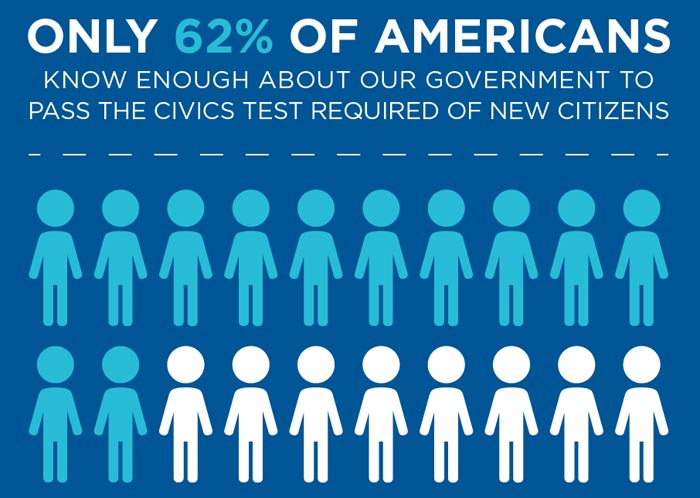
So they say only 62% of us could pass the test required to become a citizen, huh? That’s actually not too bad when I think about it!  That would be 62% without any preparation for the test.  If we knew we were taking a test, and spent even a little time preparing, I’m sure that number would be closer to 90%.

Here is a sampling of what may be asked. How will you do? (The answers are at the end.  Don’t peek!)

1. Who is in charge of the executive branch?

a) The President

b) The Speaker of the House

c) The Majority Whip

d) The Chief Justice.


2. How many U.S. Senators are there?

a) 50

b) 100

c) 200

d) 435


3. What is the economic system in the United States?

a) capitalism

b) socialism

c) communism

d) bartering


4. Who can veto bills?

a) The Congress

b) The President

c) The Vice President

d) The Senate


5. The idea of self-government is in the first three words of the Constitution. What are these words?

a) Life, Liberty, Happiness

b) Be it Resolved

c) We the People

d) Make no law


6. When was the Declaration of Independence adopted?

a) July 4, 1776

b) December 7, 1941

c) January 1, 1800

d) May 25, 1787


7. Who was the first President?

a) Thomas Jefferson

b) George Washington

c) Abraham Lincoln

d) Benjamin Franklin


8. What ocean is on the West Coast of the United States?

a) Pacific

b) Atlantic

c) Indian

d) Gulf of Mexico


9. What is the capital of the United States?

a) New York, NY

b) Philadelphia, PA

c) Boston, MA

d) Washington, DC


10. How many justices are on the Supreme Court?

a) 7

b) 8

c) 9

d) 12


Answers: 1a, 2b, 3a, 4b, 5c, 6a, 7b, 8a, 9d, 10c.

americans-pass-civics-test

Media Bias in Black and White.

A “tweet” from the Associated Press, February 2, 2015:

BREAKING: Obama sends $4 trillion spending plan to Congress, pledging help for the middle class.


A “tweet” from the Associated Press, February 9, 2016:

BREAKING: Obama sends record $4.1 trillion spending plan to Congress to combat terror threats, global warming.


A “tweet” from the Associated Press, February 12, 2018:

BREAKING: President Trump sends Congress $4.4 trillion spending plan that features soaring deficits.

media bias


Blog at WordPress.com.

Up ↑